

Author:yucheng Time:2025-12-18 16:20:32 Views:87
Key points for daily maintenance of automotive starter motors
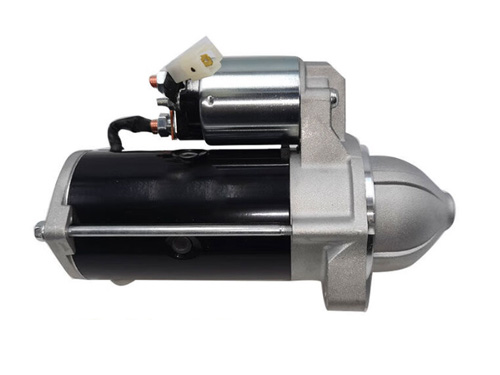
As the core power component for engine starting, the working reliability of the car starter directly affects the starting performance of the vehicle. Daily maintenance should revolve around four core dimensions: cleaning, lubrication, circuit inspection, and mechanical component testing. The specific points are as follows:
1、 Appearance and Cleaning Maintenance
Regularly clean surface stains
Regularly (recommended every 1-2 months or during routine vehicle maintenance) wipe the starter housing to remove dust, oil, mud, and other impurities adhering to the surface. Oil stains can accelerate the aging of components, and sediment can easily enter the internal meshing mechanism, causing jamming. When cleaning, high-pressure air guns can be used to blow away dust accumulation in the gaps, and neutral cleaning agents can be used to wipe off the oil stains, avoiding direct flushing of the motor interior with water.
Check the sealing of the casing
Observe whether there are cracks or deformations in the starter housing, and whether the sealing rubber ring at the wiring terminal is aged or damaged. Sealing failure can lead to the intrusion of moisture and impurities, causing internal coil short circuits or component corrosion. If the sealing gasket ages, it should be replaced in a timely manner.
2、 Circuit system inspection
Tightening and oxidation treatment of wiring terminals
Focus on checking the connection between the starter power line (thick terminal) and the control line (thin terminal) to ensure that the bolts are securely fastened and not loose. If the terminal oxidizes or rusts, it needs to be sanded to remove the oxide layer, coated with conductive paste, and re tightened to prevent excessive voltage drop and insufficient starter speed during startup due to poor contact.
Line insulation testing
Visually inspect the insulation layer of the power and control lines for damage or cracking, in order to prevent the starter from starting or burning out due to a short circuit in the circuit. If damage to the insulation layer is found, it is necessary to promptly wrap it with insulation tape or replace the circuit.
Battery voltage matching inspection
The normal operation of the starter relies on a stable battery voltage. Regularly check the battery voltage (the normal voltage for 12V passenger cars is 12.5-13.0V, and for 24V commercial vehicles it is 24.5-25.0V) to ensure sufficient voltage and no loose or corroded terminals, avoiding insufficient electromagnetic switch suction force and engagement failure caused by low voltage.
3、 Lubrication and Testing of Mechanical Components
Lubrication of drive gear and one-way clutch
Every 6 months or 10000 km, a small amount of special high-temperature grease shall be applied to the tooth surface of the starter drive gear and the one-way clutch surface. The grease shall be low temperature resistant and anti-aging type to avoid the use of ordinary grease (easy to melt and lose at high temperature). The purpose of lubrication is to reduce wear during gear meshing and prevent tooth surface peeling caused by dry wear. Attention: The amount of lubricating grease should be moderate, as excessive amounts can easily adsorb impurities and cause sticking.
Flexibility inspection of meshing mechanism
After disconnecting the negative terminal of the battery, push the drive gear by hand and check if it extends and retracts smoothly without any jamming or abnormal noise. If the gear expansion resistance is too high, it is necessary to disassemble and check whether the guide bushing is worn and whether the reset spring is fatigued. If necessary, replace the bushing or spring.
Unidirectional clutch function test
Grasp the drive gear and rotate it clockwise and counterclockwise respectively. Under normal conditions, it should rotate smoothly clockwise and lock counterclockwise. If both directions can rotate or the rotation is stuck, it indicates that the one-way clutch is slipping or malfunctioning and needs to be replaced in a timely manner.
4、 Regular performance testing
No load speed test
When the vehicle is turned off, in neutral (manual) or P (automatic) mode, briefly turn on the starter (with a single start time of no more than 5 seconds and an interval of no less than 15 seconds between two starts), and observe whether the starter runs smoothly and has no abnormal noise. If there is low speed, shaking or abnormal noise, it may be due to internal coil failure or bearing wear.
Load startup observation
When starting the engine, pay attention to the sound of the starter engaging at the moment. Under normal circumstances, the engine should start smoothly after a "click" engagement sound. If there is a "dada" sound or idling sound, it is necessary to troubleshoot the engagement mechanism or one-way clutch.
5、 Precautions for maintenance under special working conditions
Low temperature environment maintenance
Before winter arrives in cold regions, it is necessary to additionally check the battery capacity to ensure sufficient discharge capacity at low temperatures; Check the lubricating grease inside the starter motor. If ordinary lubricating grease is used, it should be replaced with a low-temperature resistant model to prevent gear jamming caused by grease solidification.
Maintenance under high load conditions
Operating vehicles that frequently start and stop (such as taxis, logistics vehicles) or construction machinery vehicles need to shorten the maintenance cycle of the starter motor (it is recommended to check it every 3 months or 5000 kilometers), with a focus on the wear of the one-way clutch and drive gear to avoid premature failure of components due to high load operation.

Copyright © 2025-2026 Cangzhou Yucheng Automobile Accessory Co.,Ltd. All Rights Reserved
